BECAUSE OF YOU…
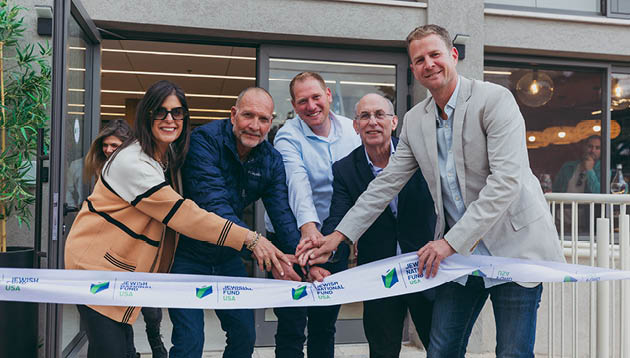
An Innovation Tech hub has opened in the desert, signifying hope and growth for the remote town of Mitzpe Ramon. Immediately after October 7th, Mitzpe Ramon, a small town in the Negev desert - with a population of just 5,000 - opened its community to over 3,000 Israelis evacuees. But as time went on, most of the evacuees left. The main reason for their departure is that Mitzpe Ramon has few prospects of employment. This past March, through a partnership with Jewish National Fund-USA, the town opened its first Innovation Hub for tech companies. The Hub will serve as a communal, open-space work environment with a goal of meeting the needs of tech-based and self-employed professionals and attracting startup entrepreneurs to work and live in the area. This is Mitzpe Ramon’s first office building.
Says JNF-USA CFO Mitch Rosensweig about this tech hub in the desert, “Despite the unparalleled challenges Israel has faced over the past year, our Jewish homeland continues to reach for the stars — quite literally — through our new Mitzpe Ramon Hub that’s attracting leading space exploration start-ups. The opening of this incredible entrepreneurial workspace represents an important milestone for Israel’s south at a time when it has never been more important to attract highly skilled employment opportunities to the region. Everything Jewish National Fund-USA does — every initiative, program, and project we create — is grounded in our strategic vision to attract 800,000 new residents to Israel’s north and south. To achieve this vision, we must ensure that new residents have access to great schools, medical care, parks, playgrounds, and other amenities that you’d find in Israel’s central cities. Our Mitzpe Ramon Hub plays a critical role in this vision, and we’re excited to see it attract more top talent to the region.” For information about the new Tech Hub, contact Leila Mikal at lmikal@jnf.org
Israelis can feel more secure with new Emergency Response Centers near their communities. A multipurpose emergency response center in the Central Arava along the Israel-Jordanian border built a decade ago by Jewish National Fund-USA is now the model for new emergency response centers (ERCs) being built by JNF-USA in response to October 7th. When the war broke out, ERCs quickly became epicenters of security and civil services. Thousands of people were protected as several of JNF-USA’s partner communities were able to fend off infiltrations and go to the aid of nearby kibbutzim and moshavim who weren’t as well-equipped. New ERCs are crucial to help instill a sense of security in the residents who want to return home but are afraid. Says JNF-USA CEO Russell Robinson, “Our Emergency Response Centers, vital to the feeling of security these communities need, are not just physical manifestations of security that will house fire, rescue, civil defense, and medical services; they signal to the volunteers who will operate out of them that their destiny is in their own hands; it’s something they can control, a feeling very much needed today.”
The current JNF-USA-built Arava Emergency Response Center (ERC) is the central command station for the Arava. It houses both police and fire personnel, gathers all essential emergency units, and allows a more coordinated, efficient, prompt and functional response to any urgent event or crisis. Volunteers and professionals protect, guard, and save lives from the ERC which provides them with the tools, equipment, and knowledge.
As part of JNF-USA’s Build Together and Reimagine plans, a comprehensive new fire, rescue, and civil defense ecosystem is being developed. This will include equipment, physical training, and the centralization of operations and resources. The system will be executed by well-equipped and well-trained volunteers in security; first responders for fire, rescue, and medical services; and will work together with local and national bodies such as the Israel Fire Authority, the IDF, the Home Front Command, EMS services, and local municipalities. The state-of-the-art facilities will incorporate training, cross-collaboration, and communication to ensure comprehensive emergency response. Centers will also include fire scouts and teen volunteers to instill civic values.
People in the Eshkol area will be better prepared in a crisis. Eshkol, midway between Ashkelon and Beersheva is bounded on the west by the Gaza Strip. These people — in particular — are always reminded to “be prepared.” Evaluate your family’s plans. Stockpile food, water and medications. Have alternative sources of light. Be ready to go to a protected space and stay for 72 hours or more.
Shared shelters are common in older apartment buildings in Israel. Lacking this option, the army's Home Front Command says to go to an internal stairwell or to a middle floor landing. “Miklatim” or public shelters can be found in some neighborhood streets. But Israelis often don’t have enough time to run to a distant bomb shelter. When the rocket sirens sound, day or night, Israelis have only seconds or a minute and a half at most, to get in a “safe room” or other protected space.
As with so many of Israel’s critical needs, JNF-USA is working to help ensure that the Israeli families returning to Eshkol have a secure place to be when under attack. Says JNF-USA CEO Russell Robinson, “In Eshkol, the big topic is the dire need for safe rooms. For people to move back, they want a house with a safe room, but at a cost of $150,000 each they are unaffordable for most.” Many homes do not have safe rooms.
Called a “mamad,” a safe room is a room right in the home with walls that are made of reinforced concrete and a heavy, airtight iron door. Safe rooms have electrical outlets, a phone and a TV/radio socket, plus a ventilation system. Mamads often serve double duty as bedrooms, playrooms, or offices. But they must always be ready to use in an emergency. JNF-USA is entering into an agreement to help pay for some of the safe rooms in Eshkol. The Israeli government will contribute, as well as the residents (with a favorable loan provided by the banks). Help us raise money for more safe rooms in Eshkol by donating to our Resilience Campaign. CLICK HERE.
Penny Bustin, Phd, writer/member of WFI newsletter committee
Written by Roni Wolk, Chair WFI Newsletter, member of National WFI Executive Board, Circle of Sapphire