FROM B’YACHAD MAGAZINE
A Family’s Journey From Healing To Hope
2f6b6f23-a42c-440d-9f55-6a8c9417d6a6.jpg?sfvrsn=b54acaa2_1)
Featured
In the wake of October 7, young burn survivor Yael Golan is regaining her strength and confidence through life-changing hydrotherapy in her own community—part of Jewish National Fund-USA’s commitment to helping families in Israel’s South return, rebuild, and move forward together.
When Hamas terrorists set fire to their home in Kibbutz Kfar Aza on October 7, 2023, Ariel and Ellay Golan—trapped inside with their one-and-a-half-year-old daughter, Yael—made a split-second decision that would save their family’s lives.
Ariel forged a path through the flames, intensified by a gas balloon the terrorists had thrown into the house. Behind Ariel, Ellay, then a medical student, wrapped young Yael in her clothing and shielded the toddler with her body as they fled. When they finally escaped their burning home, located just a mile from the Gaza border, the family hid in a non-residential area of the kibbutz before finding a soldier who could help them.
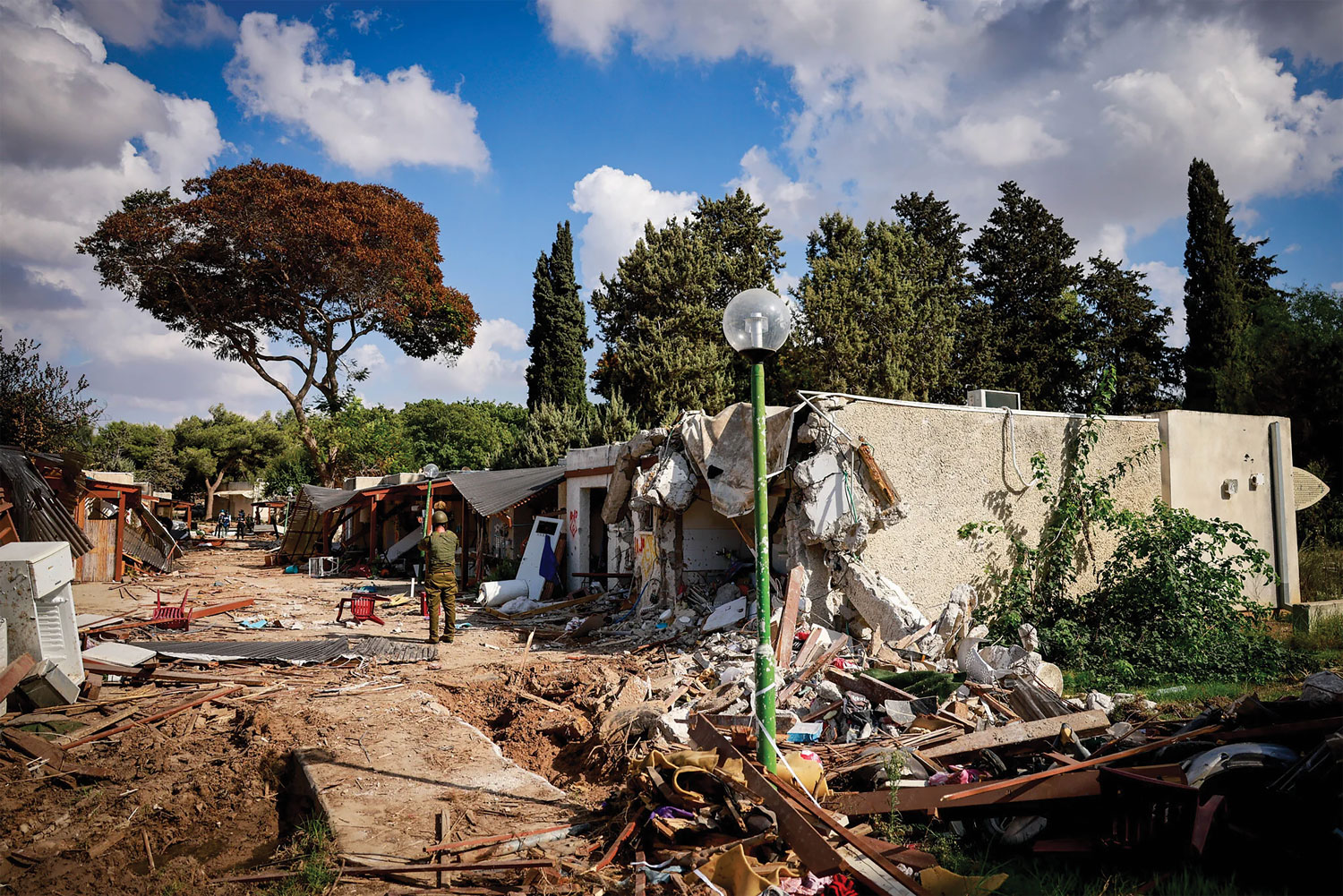 A soldier witnesses the shocking devastation in Kfar Aza following the October 7 attacks
The cost was devastating. Ariel, Ellay, and Yael all suffered severe burns, but Ellay bore the worst of it, her injuries covering 70 percent of her body. Ariel’s burns covered 45 percent of his body, and Yael, protected by her mother, sustained burns to 35 percent of her body.
As they were rushed toward a helicopter bound for Sheba Hospital in central Israel, Ellay, her own injuries overshadowed by concern for her daughter, drew on her medical training to instruct the soldiers on how to care for Yael during the flight.
What followed were the darkest months of Ariel’s life. While he regained consciousness shortly after the attack, Ellay remained sedated and unconscious for two months. Yael, remarkably resilient, was sedated for eight days and hospitalized for a month, returning to kindergarten near their temporary accommodation just weeks later.
Outside their window, the entire region was grappling with an unprecedented crisis. Rotem Assaf, head of International Relations and Partnerships for the Sha’ar HaNegev Regional Council, and Ariel’s childhood friend from Nir Am, recalled the chaos of those early days. “We had no way to deal with the enormity of the emergency. There were hundreds of refugees, hundreds of injured, hundreds of people missing. The whole area was a closed military zone, and we couldn’t even get to our operations center,” Assaf says. “Tali Tzour Avner, Chief of Staff of Jewish National Fund-USA in Israel, called us on October 8 and said, ‘Whatever you need, we will bring it. Just let me know what it is.’”
Assaf adds: “Throughout those initial weeks and months, Jewish National Fund-USA stood by the regional council, helping them establish a new operations center protected against missiles and refurbished for full functionality. It was a lifeline during a time when everything seemed to be falling apart.”
The Golan family reached a long-awaited turning point of their own. Around day 115 of the war, Ellay, now awake, was finally released from the hospital. The family was transferred to the rehabilitation center at Sheba Hospital and, together, they began the long journey of recovery.
During his three months of therapy, Ariel continued working remotely in the mental health field, trying to preserve a sense of normalcy as his family healed. Ellay occupied the dual roles of patient and caregiver, navigating her own trauma while tending to Yael and supporting the family’s recovery.
Having lived in central Israel near Sheba Hospital for an entire year, the family remained separated from their Kfar Aza community, scattered like so many others in the aftermath of October 7. But in November 2024, they made the decision to return—not to Kfar Aza itself, but to the neighboring Kibbutz Ruhama within the Sha’ar HaNegev Regional Council, where their community had been evacuated. “We came back to Ruhama because we wanted to be back with our community,” Ariel explains. “We can’t go back to Kfar Aza because we can’t face what happened there, like a lot of families. But the community is incredibly important to us, and being back together has helped us return to ourselves.”
It was after moving to Ruhama that Yael, now growing into a bright young girl, began attending therapy sessions at the Hydrotherapy Center supported by Jewish National Fund-USA, in her own Sha’ar HaNegev community. Hydrotherapy uses warm, therapeutic pools to reduce pain, improve mobility, and support emotional recovery, making it especially effective for trauma survivors and those healing from physical injuries. Jewish National Fund-USA renovated the center to serve residents of Sha’ar HaNegev and surrounding communities, ensuring civilians and soldiers wounded on October 7 have access to advanced rehabilitative care close to home.
10e3fc6d-622e-4308-95e0-86cf6b8b60b3.jpg?sfvrsn=f3d2ede9_1)
.jpg?sfvrsn=a09f1a22_1)
.jpg?sfvrsn=6281cf27_1) The Sha’ar HaNegev Hydrotherapy Center, newly renovated by Jewish National Fund-USA, provides tailored, warm-water therapy for IDF veterans, terror survivors, and residents with physical disabilities, including specialized care for children
The Sha’ar HaNegev Hydrotherapy Center, newly renovated by Jewish National Fund-USA, provides tailored, warm-water therapy for IDF veterans, terror survivors, and residents with physical disabilities, including specialized care for children
This initiative is part of a larger movement from Jewish National Fund-USA, turning urgent relief into lasting change for Israel’s most vulnerable areas. Through the organization’s strategic vision for Israel’s North and South, every program, project, and initiative creates expanding circles of impact—strengthening communities, generating economic opportunity, and supporting long-term population growth across the country’s frontier regions.
For Yael, now almost four years old, the water therapy provided a safe, restorative space to support her physical and emotional healing. During weekly sessions, Yael walks on floating mattresses and navigates various water-based obstacles, building confidence that carries over to the land. “The hydrotherapy helps build her strength and muscle development, and her overall sense of confidence,” Ariel explains. “It helps her acclimate to new situations.”
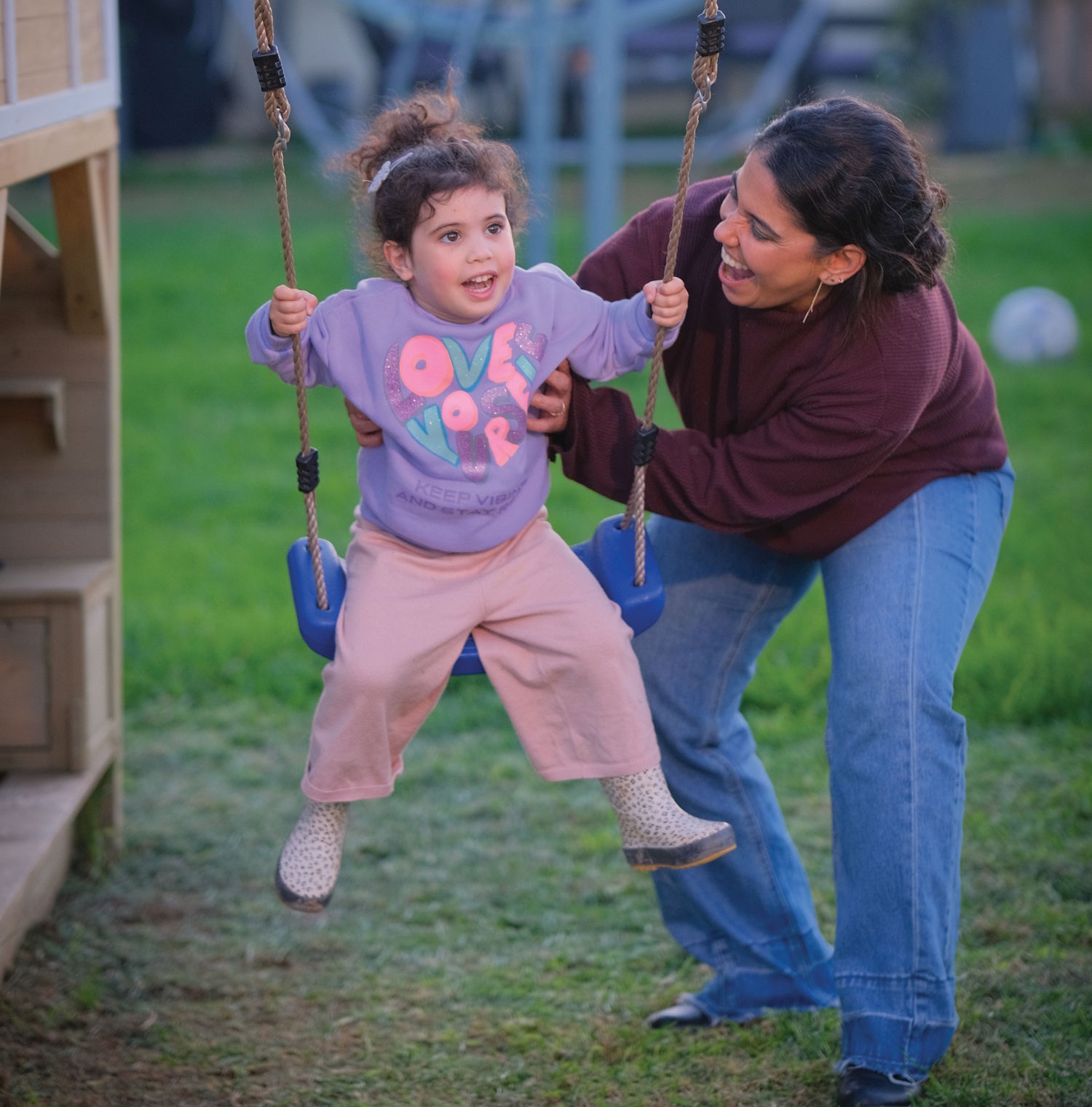 Ellay pushes young Yael on the swings (photo by Virginia Khalifa)
While Yael continued to make progress in her therapy sessions, her parents were also rebuilding their lives. Determined to complete her medical training, Ellay resumed her clinical rotations at Sheba Hospital while still undergoing treatment. She completed her internship there in July 2024, and by November of that year, she began her residency as an anesthesiologist at Soroka Medical Center in Be’er Sheva in southern Israel. Ariel, meanwhile, had shifted his focus from his work in mental health to helping rebuild their new community, understanding that collective healing was as important as individual recovery.
Then came the most profound expression of hope: they welcomed a son, Yiftach, choosing to grow their family despite all they had been through. “Children are a great force, and we knew that they were our hope after October 7,” Ariel says. “Yes, it is hard for us, but there is always hope, and our children remind us of that.”
Now, the family is committed to keeping their community together within the same regional council. “We love the people here and the community, and many, like us, have chosen to stay because of that,” Ariel reflects.
The Golan family’s story, marked by perseverance and resilience, is a powerful part of Jewish National Fund-USA’s circles of impact. Every project, program, and initiative, and every strategic investment in critical medical infrastructure such as the Hydrotherapy Center, helps families like the Golans return home, plant roots, and rebuild what the war sought to burn down. By choosing to stay, the Golan family has become a catalyst for communal growth. Day by day, they are writing a new chapter—one shaped not by the darkness of what was lost, but by the light of what they are determined to build.
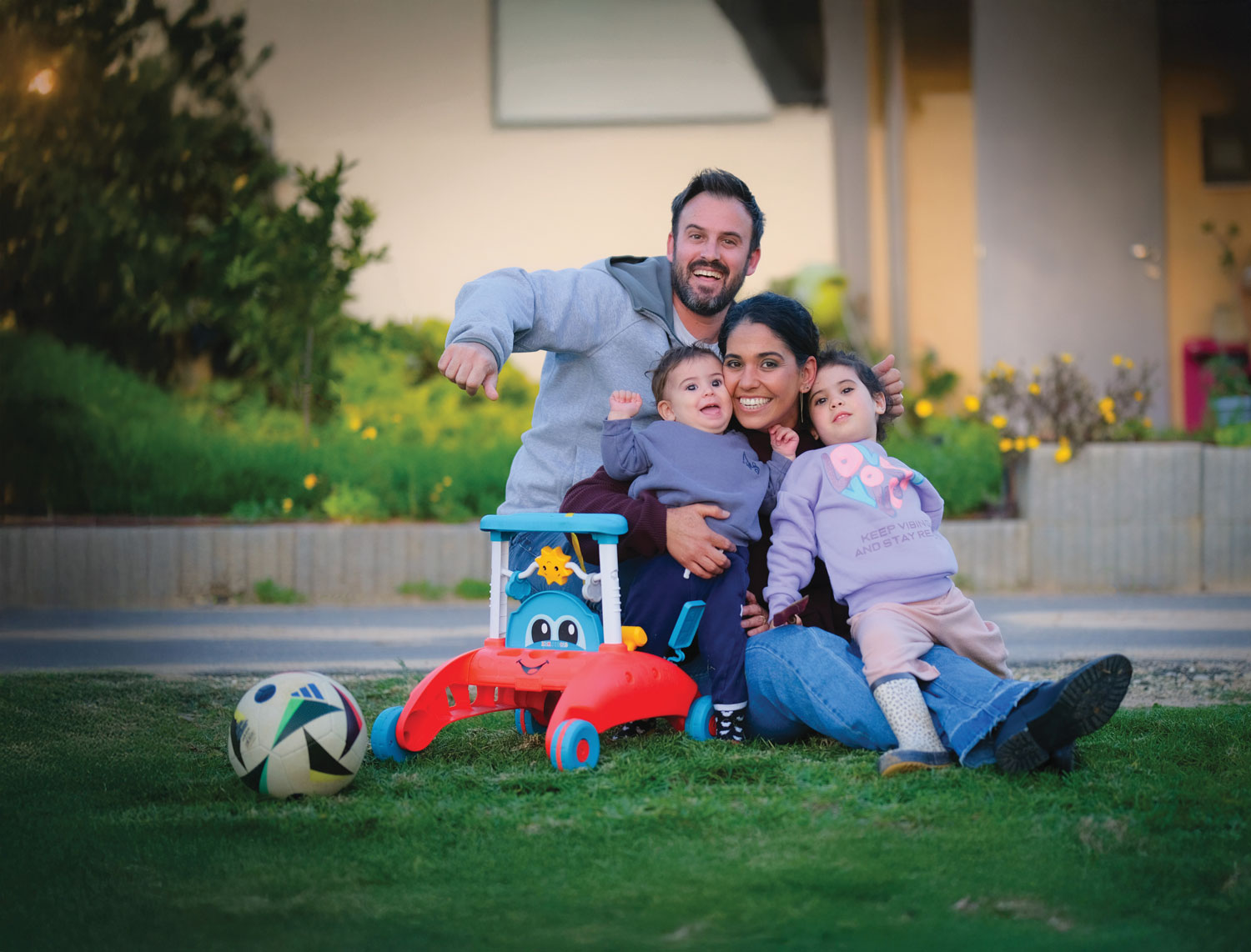 The Golan family, including their newest member, Yiftach (photo by Virginia Khalifa)
Read more stories of strength, resilience, and hope like the Golans’ at jnf.org/byachadmag
 Back
Back