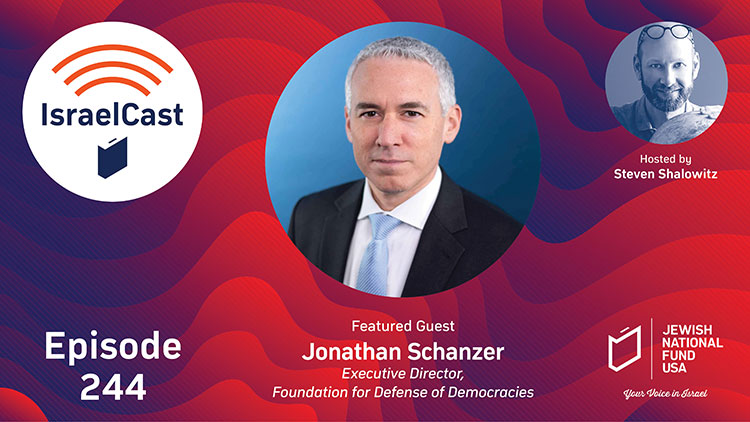
The Middle East rarely changes quietly. It shifts with moments that reverberate across the world. That sense of upheaval was unpacked on the latest episode of IsraelCast, featuring Dr. Jonathan Schanzer, Executive Director of the Foundation for Defense of Democracies (FDD), in a wide-ranging conversation about Iran, Israel, and a region in flux.
Schanzer frames the global picture through what FDD calls the “axis of aggressors”: “three really heinous regimes trying to upend the American world order—China, Russia, and the Islamic Republic of Iran.” While China and Russia loom large, Schanzer argues Iran is the most volatile—and vulnerable—player. “The Islamic Republic is in deep trouble,” he says flatly, pointing to years of protests, economic collapse, and a population that has “had its savings wiped out” as the currency spirals and basic services fail.
That internal weakness has been compounded by recent military blows. Schanzer describes how Israel’s actions and U.S. strikes shattered Iran’s sense of impunity. “The regime really was discredited by the military action,” he explains, noting that long-touted air defenses “simply didn’t work.” The result is a regime under pressure at home and exposed abroad.
Equally striking is Schanzer’s assessment of Iran’s terror proxies. “The axis of resistance is in total disarray right now,” he says. Hamas is “barely able to function,” Hezbollah has lost the majority of its arsenal, and other militias appear deterred or fractured. “They are as weak as I’ve seen them since probably the late 1980s.” For Israel, this represents a dramatic strategic shift. “Israel hasn’t won,” Schanzer cautions, “but it is definitely in a more advantageous position.”
The episode also explores the choices facing Washington. Schanzer outlines three paths: diplomacy, degrading Iran’s military capabilities, or what he calls “going for the kill” against the regime’s leadership. But he warns listeners not to underestimate uncertainty. “This isn’t the fog of war,” he quips. “It’s the fog of Trump.”
Beyond Iran, Schanzer paints a picture of a Middle East reshaping itself in real time. Saudi Arabia, the Gulf states, Turkey, and Qatar are all maneuvering amid what he calls a growing power vacuum. “Nature abhors a vacuum,” he notes, and regional actors are already “throwing elbows” to fill it. On normalization, he remains cautiously optimistic, describing Indonesia as “the big prize” that could signal broader change across the Muslim world.
Underlying the entire conversation is history. “History doesn’t repeat, but it rhymes,” Schanzer says, reflecting on rising antisemitism and Israel’s place in a turbulent world. For listeners, this episode of IsraelCast offers more than analysis—it provides perspective, clarity, and a reminder that moments like this do not come often, but when they do, they shape what comes next.
Listen now at: https://www.jnf.org/menu-3/news-media/israelcast/jonathan-schanzer-iranbrink