
By Stefan Oberman
In a region where up to 90% of children have some form of PTSD, therapist and mother of three Noa Dotan has her work cut out for her. Having endured tens of thousands of rockets from Gaza for over a decade, Dotan must care for the mental health of her children, her community, and her own.
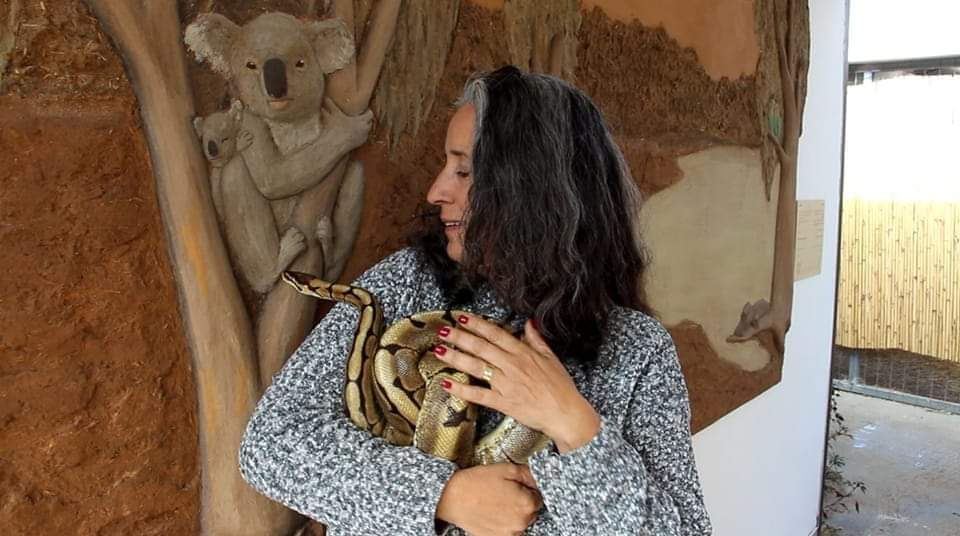
Noa Dotan at Jewish National Fund-USA's Animal Therapy Center in Sderot
“Over the past 22 years, I have been raising my children here in the Gaza Envelope region,” Dotan remarks proudly.
And she has every reason to be.
Living in an Israeli frontier town isn’t easy, especially when it’s located on the border with Gaza. And despite the challenges, her family has shown remarkable resilience in the face of terror.
“My oldest child, who is now 22 years old, once had a rocket fall nearby them. My middle child, who is currently in the Israel Defense Forces, has experienced panic attacks since kindergarten. My youngest, now 17 years old, was heading to summer camp when a missile struck next to the bus stop they were waiting at. Does it take a toll on us? Of course. However, we have developed the tools to deal with it, and everyone should know that our community isn’t going anywhere.”
Thankfully, Dotan appreciates that she and her community are not alone. Her hometown of Sderot has experienced over 50% population growth since the year 2000 in part because of organizations like Jewish National Fund-USA. Through its philanthropic investments and strategic vision, it has created fortified schools, bomb shelters, indoor play centers, housing development sites, and more.
Although it may not be the norm in other communities worldwide, mental health is widely discussed and embraced in Sderot. And together with Jewish National Fund-USA, the organization has invested heavily in creating resilience centers like the one Dotan works at.
“We are not anxious parents; however, two of our children suffer from severe anxiety due to the security situation,” said Dotan. “ This, in turn, changes the parenting process as life here alternates between ‘routine’ and ‘crisis.’ As a parent, one needs to pay close attention to their child and exercise judgment when a [security] situation arises until it has calmed down. We have to watch our children for signs of anxiety attacks and then treat them. In addition, as parents, we have to behave in a way that brings calm.”
In Dotan’s line of work, her skills are constantly being used. “I am an emotional therapist here in Sderot. Our resilience center has treated countless community members, including two of my children. My partner and I also receive ongoing training here. In addition, I see a psychologist once a week to strengthen my mental health and coping resources so I remain resilient in front of my children and patients.”
As Mother’s Day, or “Family Day” as it’s known in Israel, approaches, Dotan, like countless others, will be celebrating but also thinking about those no longer with her. “Family Day is a special time for us,” she said. “It’s significant for me because I’m given pause to remember my late mother, who was such a role model. I hope, like her, I can set a good example for my children.”
As countless women and mothers like Dotan continue to strengthen their communities in the Negev and Galilee, they do so with the knowledge that they are ensuring Israel’s future prosperity, security, and resilience while serving as the Zionist halutzim (pioneers) of the 21st century.
Support Israel’s pioneering communities in the Gaza Envelope today at jnf.org/gazaenvelope