JNF-USA, in partnership with The Society for the Preservation of Heritage Sites, is helping Israeli women heal.
Noa Gefen, Executive Vice Chairperson of The Society for the Preservation of Israel Heritage Sites (SPIHS) says, “We cannot undo what these communities have endured, but we can continue to stand beside them, embrace them, and give them moments of strength, connection, and hope, and that is exactly what we intend to keep doing for Israel's northern and southern communities.” Gefen is referring to the Jewish National Fund-USA (JNF-USA) supported SPIHS Resilience Programs designed to address the needs of Israelis impacted by October 7.
It is estimated that hundreds of thousands of Israelis are coping with psychological trauma, either on its own or alongside physical injuries, since the brutal October 7, 2023, attack and ongoing conflict. This staggering figure includes Israelis living with symptoms of PTSD, anxiety, depression, and/or impaired functioning with or without a formal diagnosis.
There are about 150 heritage sites throughout Israel offering resilience programs. To date, approximately 400 thousand Israelis have participated. Most of them are women—war widows, bereaved mothers, female soldiers, partners of reservists, traumatized seniors, children who have lost parents, and others. “We are focusing on the women because they are the caretakers, the ones who are left. We believe that if the women are strong, the society will get stronger,” says Tania Shalom Michaelian, Partnership and Development Manager at SPIHS.
Although a variety of JNF-USA-supported affiliates are engaged in resilience programming, the programs at the SPIHS sites weave together the significance of the site itself with relevant healing activities. “We use the stories at the heritage sites to convey the message to those suffering that just as the people of Israel have overcome severe obstacles from the start, today’s Israelis are a continuing part of our story. They, too, can carry on and thrive again,” says Michaelian.
Until October 7, the Sea Museum at Kibbutz Palmachim, a heritage site in the heart of Israel and perched on a cliff overlooking the Mediterranean Sea, showcased artifacts found in the region of the kibbutz and offered school tours and educational programs focused on maritime history. But October 7 changed everything. Staff members questioned the museum’s place in a country suddenly consumed by trauma. Recognizing the healing power of water, museum staff quickly began shaping what would become the By the Sea Resilience Center, blending heritage work with movement-based and water-oriented practices. Since that horrific day, the staff has learned that healing can begin at the water’s edge. “People come here, and something in them settles,” says social worker and surf instructor Ido Rom. “The water quiets whatever is loud inside.”
Revital, the mother of Idan Herman from Kibbutz Palmachim, who was murdered by Hamas terrorists at the Nova Music Festival has taken part in programs at the Sea Museum. She gained so much from her participation that she returned several times and has encouraged other bereaved families to join the workshops. Bereaved mothers of those murdered at the music festival even screamed into the waves and then surrendered themselves to the buoyancy of the sea. “The activity allowed me to breathe again today,” said one of the mothers.
Another Sea Museum program was conducted for the children of Nir Yitzhak, a kibbutz near Gaza that was brutally attacked by about 90 Hamas terrorists. The children continue to suffer from the trauma of having spent so many hours hiding in their safe rooms, terrified the terrorists would find them. One of the many heart-wrenching stories that emerged was about a little girl who was hesitant to join her friends in the water. Eventually, she agreed to go out in a kayak with Avri, a volunteer whose son was murdered at the Nova festival. While in the waves, the girl told Avri that her father, too, had been murdered on October 7. Avri listened. Just listened. These two very different people were deeply connected by a shared tragedy and found comfort in the gentle rocking of the sea and in the company of someone who truly understands them. "Making these programs accessible is about creating an environment in which people feel safe, understood, and able to participate in a way that suits their needs," says Michaelian.
Dubrovin Farm, also supported by JNF-USA, is a historic pioneer farm and museum in northern Israel with its own resilience program. The farm was established in 1909 next to malaria-ridden swamps. These pioneers overcame the devastating loss of family members to malaria and successfully built an agricultural homestead. Today, educators teach visitors about endurance, recovery from grief, and ultimately survival. “Dubrovin is a living, breathing museum. Every corner tells a story,” says a volunteer at the site who is also a fifth-generation resident of the community and descendant of the first aliyah of pioneers.
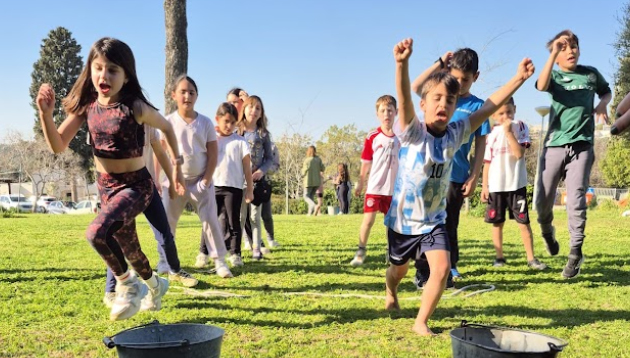
When families up north were endlessly stuck inside bomb shelters, a team from Dubrovin brought resilience programming to them. Armed with costumes, the volunteers encouraged the children to dress up and be “brave pioneers.” "The hour of joy that you brought to my daughter and her little friends in the bomb shelter today will carry her through the next few days," said a mom of a kindergartner from a kibbutz in the north.
It costs about $100,000 per month to run these programs. They are managed and aided mostly by retired social workers, teachers, psychologists, psychiatrists, and volunteers, as well as young people fulfilling their national service. Although they are also suffering, there are not enough funds to care for them, too.
Gefen reminds us, “Even though almost three years have passed since the October 7 attack, we are still feeling its aftershocks. Deeply traumatized communities are trying to regroup and rebuild, and we have vowed to continue helping them for as long as we are needed.”
Support Israel’s resilience. Your partnership helps Israelis heal, rebuild their lives, and thrive.
On a personal note, I volunteered to write this article because the notion of resilience resonated with me. Having lost our Pacific Palisades community, our home of thirty-four years, and all its contents in last year’s conflagration, I have felt loss and upheaval. We even have an organization called Resilient Palisades. But I count myself and my husband among the lucky ones. In no small measure, I attribute my having bounced back, perhaps more quickly than most, to a constant voice inside my head reminding me that our day of loss—January 7, 2025, was no October 7, 2023. What we suffered was not a vicious attack by terrorists bent on annihilating us. We lost structures and possessions. Not our lives.
Written by Betsy R. Rosenthal, Sapphire Society member
Edited by Roni Wolk, Chair of this newsletter, member of Women for Israel National Executive Board, Chair of Jewish National Fund-USA's Disabilities Task Force