JNF-USA is able to help Israel–a country with little water, an arid climate, and the Negev desert covering half of it– thrive with effective water management.
Israel is a country with little natural water, an arid climate, and a desert, the Negev, covering half its landmass. The fact is, water scarcity has shaped Israel since its founding. Despite these challenges, Jewish National Fund-USA (JNF-USA) is helping our homeland thrive. Effective water management, innovative solutions, and long-term visionary planning is making the difference.
Noa Zer, former Resource Development Director of the Central Arava Regional Council, describes the reality plainly: “In the Arava, all things water-related are challenging.” The region makes up 22% of Israel’s landmass, is home to 1,100 farming families, and receives only about one inch of rain each year. Here, water is not simply an environmental issue; it determines whether farmers can grow food, and communities can thrive and grow.
She goes on to explain: “If you would show European farmers the salinity level of our water in the Arava, they would say, ‘you can’t grow anything here.’ Yet we manage to grow some of the best produce in the world!”
Water scarcity has shaped Israel since its founding. As part of its support for the land and people of Israel, JNF-USA has partnered with Israeli water authorities, local communities, and generous donors to develop critical water infrastructure. This work has focused on water recycling, reservoirs, floodwater collection, and environmental restoration—and the results are impressive.
Israel currently reuses 90% of its wastewater, making it the world leader in this area. To achieve 95% recycled water, Israel needs 90 additional reservoirs.
Tali Tzour Avner, JNF-USA’s Chief of Staff in Israel, explains why this work matters far beyond Israel: “Farmers and scientists from around the world look to Israel to see how we can prepare for a future where we need to conserve resources while maximizing our output.” Several U.S. utilities have invited Israeli experts to advise them on how to increase agricultural water reuse in their regions.
Part of JNF-USA’s support focuses on infrastructure that takes sewage/wastewater, treats it, stores it in reservoirs, then sends it to farms for irrigation. This has two benefits. First, this provides more water availability while freshwater is conserved for drinking and household use. Second, 10% is used for environmental purposes, such as increasing river flow volume and fire suppression.
The new Hatzeva Wastewater Treatment Plant is a vital infrastructure project that will provide a modern, sustainable solution for water management in the Arava. The new facility will safely treat wastewater, increase water reuse for farming, strengthen regional water security, and help ensure the long-term sustainability of the community. Complementing the treatment plant, is a reservoir that will play a key role in storing and distributing reclaimed water for irrigation.
JNF-USA-supported reservoirs collect treated wastewater, rain runoff, flash-flood water, and in some cases, spring water. The water is then stored and used primarily for agricultural irrigation, rather than wasting precious, drinking-quality water for crops. Reservoirs provide roughly half of the water used by Israeli agriculture. Zer says: “All water for domestic use must be desalinated and… Jewish National Fund-USA [is] helping to build better water infrastructure for our entire community.”
The Zuqim Reservoir in the Arava, which captures periodic desert floodwaters, is also used to help replenish groundwater. Zuqim is the art community initially funded by JNF-USA’s original group of Sapphire Women (donors of $5,000+ annually) in 2001.
When Israel’s desert regions periodically experience climate extremes, these areas can range from extremely dry to experiencing torrential flash floods, as just happened in August of this year. JNF-USA has built reservoirs and drainage systems in the Negev and Arava to capture that water rather than allowing it to run into the Dead Sea or evaporate. The water can subsequently be used for farming. In total, JNF-USA has developed nearly 90 water-management projects in the Negev.
JNF-USA’s water work isn't only about creating more water. It also has aided in the rehabilitation of polluted rivers and streams. Projects include the Be’er Sheva River Park and Lake, Hadera River, Harod River, and Yerucham Park. The Be’er Sheva Lake uses recycled water and supplies irrigation for the surrounding park. The goal is to stop polluted wastewater from entering rivers, improve water quality, restore ecosystems, and create recreational areas.
In the North, JNF-USA has funded water drilling and research, including the Shamir Drilling project in the Galilee/Golan area.
Other, more environmentally sophisticated systems that use plants, soil, microorganisms, and wetlands to further clean water are supported by JNF-USA. For example, in central Israel, treated wastewater passes through constructed wetlands (“green basins”) before being released toward the Yarkon River. These systems can remove pollutants that conventional treatment doesn't eliminate.
Additional technologies being supported include the world’s largest lysimeter, a measuring instrument used to study water and chemical movement through soil. This allows farmers to determine precisely how much water crops need rather than wasting scarce water.
Through JNF-USA’s support of water projects, Israel’s water economy has increased by over 15% through the treatment, recycling, and collection of both waste and runoff water, responsible aquifer drilling, and river rehabilitation.
The basic idea is to make every drop count!
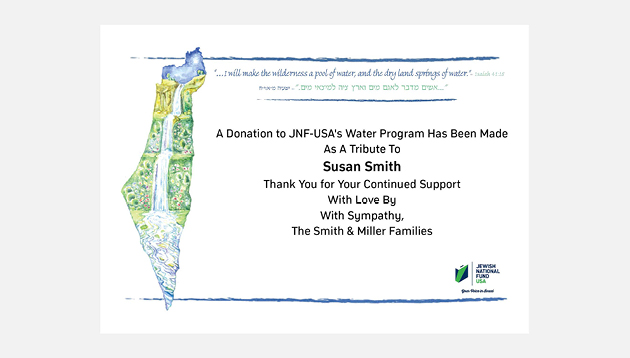
Have you planted trees in Israel with JNF-USA? Well, JNF-USA offers a Water Certificate for $18, and that donation supports its water-resource-development projects.
JNF-USA has been instrumental in building and funding infrastructure that makes more of Israel’s existing water usable. To learn more about the incredible work of Water Solutions click here.
Written by Penelope Bustin, PhD, and Lynette Feit Buzen, Vice Chair of this Newsletter and Member, Board of Directors, Long Island