When people hear the word “Zionism,” it often sparks strong reactions. For some, it is misunderstood. For others, it is judged without being fully understood. But Zionism is not a slogan or a political tactic. It is the story of a people who learned—over centuries—that survival, identity, and responsibility require a home.
I want to begin with a personal story.
My father was born into a Jewish family that had lived in Oświęcim, Poland, for nearly two hundred years. They were not newcomers; they were rooted. They had neighbors, traditions, and a sense of belonging.
In October 1939, just weeks after Germany invaded Poland, that life was destroyed. His family was taken from their home and thrust into six years of unimaginable horror. At Auschwitz, Dr. Josef Mengele sent my father in one direction and his parents and siblings in another. It was the last time he ever saw them. My father later survived a death march from Auschwitz to Dachau and was liberated by the American army in May 1945.
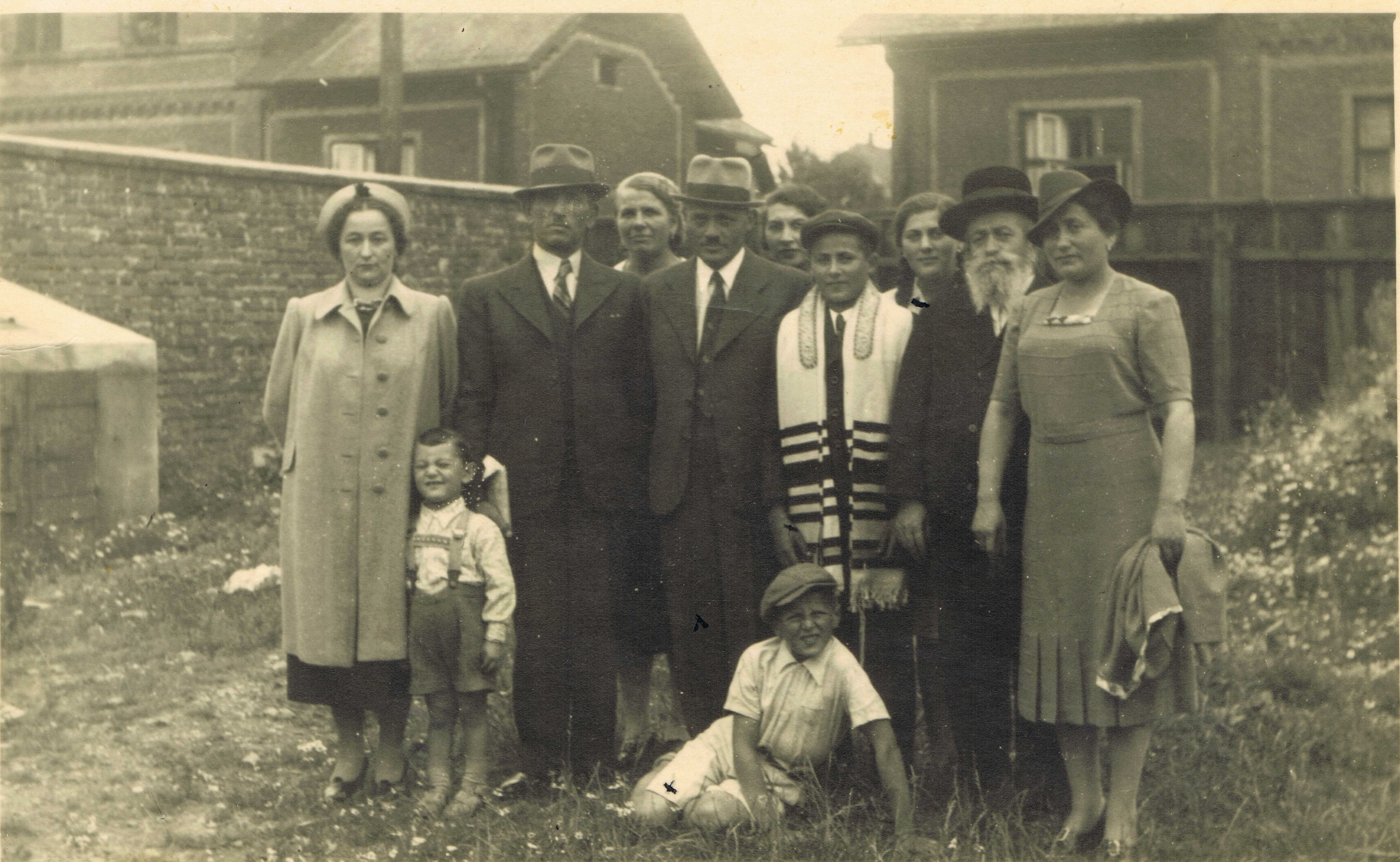
William's father among his family on the day of his bar mitzvah
That story is not unique. It is one thread in a tapestry of Jewish history that stretches back thousands of years—a history that explains, more clearly than any theory ever could, why Zionism exists.
The Jewish connection to the Land of Israel is ancient. It predates modern politics by millennia. Judaism itself was shaped in that land—its language, laws, holidays, and moral vision. Even after exile, Jews never disconnected from Zion. We prayed facing Jerusalem. We marked time by agricultural seasons tied to that land. We ended Passover with the words, “Next year in Jerusalem.” This was not nostalgia. It was continuity.
For nearly two thousand years, Jews were exiled from their ancestral homeland and lived without sovereignty in the lands to which they were dispersed. Judaism survived—remarkably so. Faith endured. Learning endured. Community endured. But safety did not.
Again and again, Jews learned that belonging was conditional. Acceptance could be revoked. Rights could disappear. And Jewish life built over generations could be destroyed in a moment.
This is the context in which Zionism emerged.
Zionism did not invent Jewish attachment to Israel. It responded to a reality Jews already knew: that spiritual survival without physical security was not enough. As pogroms and nationalism swept Europe, and as antisemitism hardened into ideology, Zionist thinkers articulated a simple but radical idea—that Jews are not only a religion, but a people, and that a people, like all others, deserves the right to self-determination.
Zionism was not exceptional. It was the Jewish expression of a universal principle. And it was never only theoretical. It was practical. It asked: How do we take responsibility for our future? How do we build, sustain, and protect a homeland?
Institutions like Jewish National Fund-USA answered those questions—acquiring land, planting forests, developing infrastructure, and turning ancient hope into living reality. Through Blue Boxes on kitchen counters, synagogues, and businesses, Jews around the world became partners in building a future.
In 1971, at 15 years old, my parents sent me to Israel for a two-month youth tour, which included a two-week working volunteer stay at Kibbutz Sde Boker. There, I had the privilege of meeting Prime Minister David Ben-Gurion, who had chosen to spend his retirement years at the kibbutz. Sitting just a few feet away, we listened to him share firsthand accounts of the early days of Israel’s history. To this day, I can still see him shaking his finger at us, declaring that "the future of Israel depended on the development of the Negev desert." Even 55 years later, the memory remains vivid. That trip deepened my understanding of Israel's significance and my own identity as a Jew.

A young William Rosenbaum takes a snapshot of david ben-gurion at his home in sde boker
Fast forward to 2020, when I attended a Jewish National Fund-USA event in San Diego. I was amazed to discover an entire organization dedicated solely to the support and development of Israel. Of course, I knew about the organization’s Blue Boxes and tree planting, but seeing what has been accomplished when hundreds of thousands of like-minded donors unite to fulfill the promise of our Zionist forefathers made an immediate and profound connection. I realized that I, too, could help fulfill that promise for future generations, just as the pioneers of our past did for us.
In 2024, my wife Sandra and I created and funded an endowment scholarship at Jewish National Fund-USA for Alexander Muss High School in Israel (Muss), honoring the memory of my Zionist grandfather, who perished in Auschwitz. As a young Zionist pioneer, he traveled from Poland to Mandatory Palestine to help build what would eventually become Israel. My grandfather and so many other Polish Zionist pioneers never got to see the formation of the Jewish State they helped create. This scholarship honors his memory and helps secure Israel’s future by ensuring that the Zionist dream is carried forward by the next generation.
During the Holocaust, six million Jews were murdered, my father’s family among them, while the world largely closed its doors. The Holocaust did not create Zionism, but it stripped away every illusion that Zionism was optional. It exposed what happens when a people has no place to flee, no power to protect itself, and no control over its destiny.
In 1948, immediately after the State of Israel was declared, it was attacked. Yet it survived. For the first time in nearly two thousand years, the Jewish people were sovereign in their ancestral homeland. That moment changed everything.
Judaism, Zionism, and the State of Israel are not separate ideas in the way they are often treated in public Jewish discourse. I believe that their futures are bound together. For each to remain vibrant and enduring, they must continue to exist in relationship with one another, sustaining and shaping each other in the generations ahead.
Israel is not just a refuge. It is a responsibility. It absorbed Holocaust survivors, Jews expelled from Arab lands, and, later, Jews from Ethiopia and the former Soviet Union. It built a society where Hebrew was revived, democracy took root, and care for the land became national policy.
Jewish National Fund-USA’s continued work—developing water systems, strengthening communities, restoring the environment—reflects a Zionism that looks forward, not backward.
Critics of Zionism often raise serious concerns. These critiques should not be dismissed—but they must be grounded in reality. Israel operates in one of the most challenging security environments in the world, facing threats that no other democracy confronts in the same sustained way. And yet, it maintains an independent judiciary, free elections, a vibrant civil society, and protections for minority rights. Debate within Israeli society is not a weakness; it is a feature of a living democracy.
Zionism does not demand perfection. It demands responsibility. It insists that Jewish sovereignty be moral, accountable, and tied to Jewish values—including justice, human dignity, and ethical self-examination.
Today, the relevance of Zionism is unmistakable. Antisemitism is rising again—across political extremes, online and in public spaces, on campuses, and in institutions. Jewish identity is challenged. Jewish spaces require security. Once again, Jews are reminded that safety cannot be assumed.
Israel changes that equation. Israel is the one place where Jews are not guests in someone else’s story. It is where Jewish survival is not conditional. It ensures that what happened to my father’s family will never again be the final chapter of the Jewish people.
Zionism is not something to apologize for. It is the decision to live responsibly as a people with the understanding that Israel, Zionism, and Judaism are the continuation of Jewish history.
That is why Zionism still matters. That is why Israel still matters.
And that is why the future of the Jewish people depends on both.