
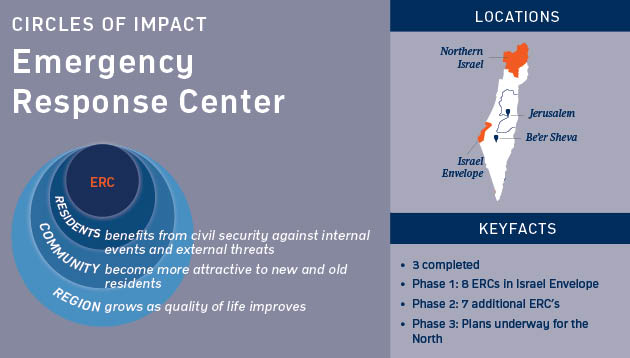
Jewish National Fund-USA (JNF-USA) is building a nationwide network of regional Emergency Response Centers (ERCs) along Israel’s borders to strengthen the systems protecting everyday life for people and communities there and, ultimately, bolstering the country’s security. Ilan Isaacson, Security Chief for the Eshkol Regional Council in the Israel Envelope, says, “I believe these ERCs will provide a great deal of reassurance to residents returning to the region.” A coordinated emergency network in a constant state of readiness in these regions is critical for creating a sense of security for residents on the border who wish to return home. These layers of preparedness will give residents a real sense of physical security, control, and the confidence to rebuild their homes and their lives.
While the ERC program existed prior to October 7, there was no unified network in place to coordinate communication, emergency responses, manpower and resources between neighboring response centers. This network will have ERCs working together to bring security and emergency services into one centralized framework. Border communities will now have “safety nets” that can strengthen and reinforce the systems protecting everyday life for people and communities there. Ilan Isaacson explains, “Now, when there is an emergency, a security concern, or even a routine security briefing, we do not have to wait for outside assistance.” JNF-USA’s CEO Russell F. Robinson says, “This is designed to strengthen communication and coordination between emergency services in [both] the Israel Envelope and northern Israel.”
As the only US benefactor of the Israel Fire & Rescue Authority, JNF-USA has strategically invested in civil defense, local security, and first responders for years. However, the needs can no longer be met by local or national government, or JNF-USA alone. JNF-USA has stepped in and asked longtime partners in Israel this critical question: “What do you need?”
What is an Emergency Response Center (ERC)?
ERCs are community-based hubs, strategically grouped in clusters and developed in coordination with local and regional agencies. They are designed to centralize critical services including the IDF, Israel Fire and Rescue Authority, emergency medical services and the Home Front Command to meet the specific emergency needs of a community. Operating under one “umbrella,” key personnel use live radar, cameras, rapid response vehicles, and regional communication systems to quickly assess needs. This coordination drives faster decision-making in the face of life-threatening situations. Since the buildings themselves are fortified, visitors and personnel can safely stay in place during times of conflict and continue their important work.
Ilan explains that ERCs will be staffed by highly trained volunteers (including adults, teens, and fire scouts) and will bring together multiple resources: firefighters, police, search and rescue services, Magen David Adom ambulance service, drone operations and medical care including mental health care. Volunteer training is extensive and ongoing, lasting several months with periodic refresher courses to supplement skillsets. Courses include first aid, defense and security, team building and working together in emergencies as first responders. “We know that when people volunteer, especially in areas related to resilience, they feel a sense of belonging and purpose. They become part of something larger than themselves,” says Ilan,
In Kiryat Shmona, a region in the North, JNF-USA is investing in an ERC that will serve as an operations hub with first response firefighting, medical care, drone piloting and operations, search and rescue services, and transportation for essential workers in the case of natural disasters such as earthquakes and forest fires.
The Eshkol region’s ERC cluster is designed differently to respond to that region’s particular needs. Ilan explains, “There are five ERCs in my municipality and three more in a neighboring one. We are in a remote area, far from immediate support, so having these capabilities locally is critical. It is important to remember that even after two and a half years, four communities have still not returned.”
Ilan concludes, “These ERCs would not exist without Jewish National Fund-USA. JNF-USA has been present from the very beginning, stepping in to support the municipality where it could not manage on its own. In many ways, they have done everything necessary to bring these ERCs to life.” JNF-USA is committed to building Emergency Response Centers that strengthen communication and coordination between emergency services while making a fundamental difference in how security and emergency responses are managed. This is JNF-USA putting resilience and preparedness into action. This is what JNF-USA did yesterday, today, and will continue to do tomorrow.
Support Israel’s Resilience
Be part of a growing movement of people who are helping shape Israel’s future through resilience, connection, and community. Learn more here.
Written by Penelope Bustin, PhD, member of WFI newsletter team and Roni Wolk, Women for Israel newsletter Chair, member of Women for Israel National Executive Board, and National Chair of JNF-USA affiliate LOTEM